
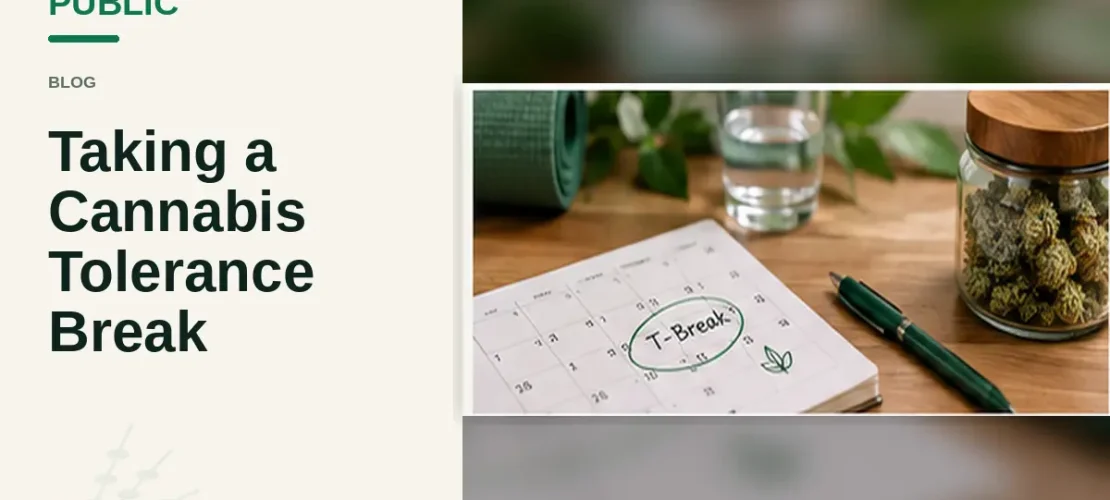
Tolerance is the most predictable thing about regular cannabis use and the one people are most reluctant to address.
The pattern is familiar. What used to be plenty becomes a baseline. You buy stronger products, take larger amounts, and the effect still sits somewhere below where it used to be.
Buying up the potency ladder works for a while. Eventually it stops, and a break becomes the more efficient answer.
Why Tolerance Builds
Your body adapts to repeated exposure. With cannabis specifically, regular THC consumption leads to a reduction in the availability of CB1 receptors — the ones THC binds to.
Fewer available receptors, less effect from the same dose.
The useful part is that this adaptation reverses. Research on receptor recovery has generally found that availability begins returning within days of stopping and moves substantially back toward baseline within a few weeks.
Tolerance is not damage. It is adaptation, and adaptations run in both directions. This is one of the few things in this space where the mechanism is reasonably well understood.
How Long a Break Needs to Be
Shorter than most people assume, which is the good news.
| Length | What tends to happen |
|---|---|
| 48 hours | Noticeable difference for lighter consumers |
| 3–7 days | Meaningful reset for most regular users |
| 2 weeks | Substantial receptor recovery |
| 3–4 weeks | Close to baseline for most people |
A weekend off is not nothing. If a full month sounds unmanageable, three or four days will still produce a real change, and it is far better than continuing to escalate.
The heavier and longer the use, the longer the return takes. That is intuitive and it holds up.
What the First Few Days Are Like
Worth knowing in advance so nothing catches you off guard.
The most commonly reported experiences in the first week are changes to sleep, vivid or unusually memorable dreams, some irritability, reduced appetite, and a general restlessness in the evenings.
Sleep tends to be the one people notice most. REM sleep is suppressed somewhat by regular THC use, and when it returns it comes back emphatically. That usually settles within a week or two.
None of this is dangerous, and for most people it is mild. If you are finding a break genuinely difficult to manage, or your use feels like it is not something you have much say over, that is a conversation worth having with a healthcare professional rather than a budtender.
Things That Make It Easier
Practical rather than profound.
- Pick a start date rather than deciding spontaneously
- Move your supplies somewhere inconvenient
- Have a plan for the specific time of day you would normally use
- Expect the evenings to be the hard part, because they usually are
- Tell someone you are doing it
Some people substitute CBD-dominant products during a break. Opinions vary on whether this defeats the purpose — CBD does not bind to CB1 the way THC does, so the receptor argument suggests it is not interfering much. Whether it helps is more individual. Topicals are the other option people reach for, since they are non-intoxicating by nature.
Coming Back
This is the part that gets mishandled.
Your tolerance has genuinely dropped, which means your old dose is now a large dose. People routinely come off a two-week break, take what they always took, and have a considerably more intense evening than they planned.
Start at roughly a quarter to a half of what you used to take.
This is a good moment for formats with precise dosing. A tincture lets you dial in small increments in a way that a pre-roll or a gummy does not.
It is also a good moment to reconsider what you buy. Coming back with a reset tolerance means mid-range flower will likely do everything you need, which is usually better value than whatever high-potency product you had worked your way up to.
Keeping Tolerance Manageable Afterward
Once you have reset, a few habits slow the climb back.
Regular scheduled days off — one or two a week — do most of the work. So does noticing when you are using out of routine rather than intention.
Varying formats helps some people. So does resisting the reflex to increase the dose the first time a session feels underwhelming, since a single flat session is often about sleep or mood rather than tolerance.
A Reasonable Way to Think About It
A tolerance break is maintenance rather than punishment.
Four days off will do more for your next session than any product on any menu, and it costs nothing. That is an unusual deal in a category where the default response to diminishing returns is to spend more.
If you are coming back and want a hand recalibrating, saying so at the counter is genuinely useful information — it changes the recommendation substantially, and it is worth adding to the list of things to mention to a budtender.

About the Author: Alex Calleres
Alex Calleres has been operating multiple 20,000 square foot cannabis cultivation facilities for the past several years. Before cannabis, he worked in the oil refinery industry, and has done a lot of work on airport construction projects.
See more about the author