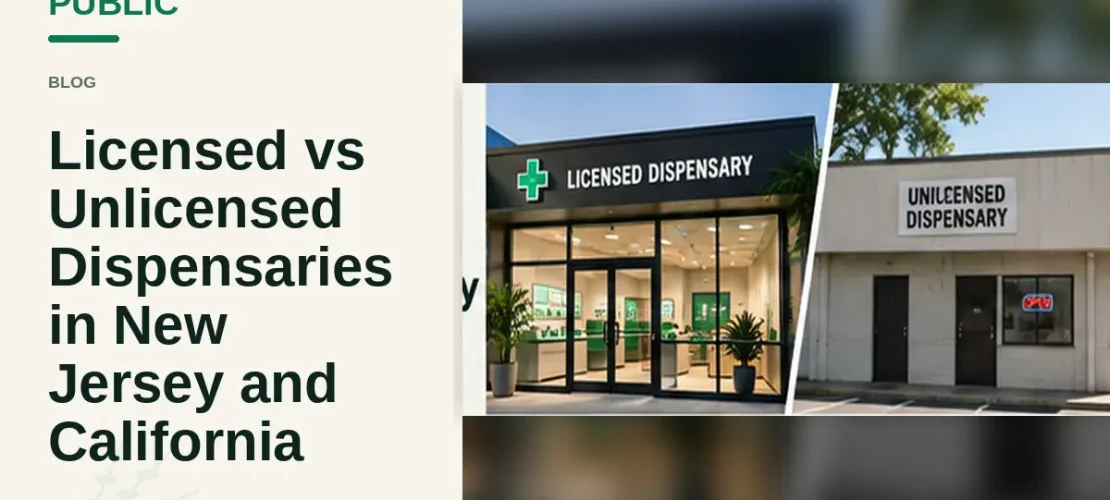
Both New Jersey and California have legal, regulated cannabis markets. Both also still have unlicensed shops operating alongside them, sometimes on the same street, often looking essentially identical from the sidewalk.
California has the larger problem, mostly because its unregulated market predates legalization by decades and never fully went away. New Jersey’s market is younger and its enforcement newer, but unlicensed operators exist there too.
The difference is not a matter of loyalty to the legal market. It is a difference in what you can actually know about what you are buying.
What a License Actually Requires
A license is not a formality. It attaches a set of obligations to everything on the shelf.
Lab testing on every batch. Pesticides, heavy metals, residual solvents, microbials, mycotoxins, and moisture content, tested against state-defined limits. Products that fail do not reach the floor. This is the part that matters most and the part unlicensed shops cannot replicate — we cover what those reports contain in how to read a cannabis lab report.
Seed-to-sale tracking. Every unit is logged from cultivation through the point of sale, so its origin is traceable.
Accurate labeling. Potency figures on licensed products come from an accredited lab rather than from whoever printed the package.
Age verification. Twenty-one and up, ID checked every visit, no exceptions. Recall capability. If a contamination issue is identified, licensed products can be traced and pulled. Unlicensed products cannot be.
The core of it is straightforward. In a licensed shop, someone has tested what is in the package and the state can find it again if something goes wrong. Outside that system, both of those things are simply unavailable.
What Gets Found in Untested Product
This is not hypothetical. Testing programs in legal states have repeatedly found problems in seized or submitted unregulated products.
Pesticides not approved for cannabis, sometimes at levels well above action limits. Heavy metals, which concentrate in the plant and then concentrate further in extracts. Residual solvents in poorly purged concentrates. Mold and microbial contamination in improperly cured flower.
The vaping illness outbreak in 2019 and 2020 was traced substantially to vitamin E acetate used as a cutting agent in unregulated vape cartridges. That episode is the clearest example available of what an untested supply chain can produce.
Extracts deserve particular caution here, since the extraction process concentrates contaminants alongside everything else. If you are buying live resin or any solvent-extracted product, the residual solvent panel is not a technicality.
How to Verify a Shop
Both states maintain public licensee information, and checking takes a minute.
| New Jersey | California | |
|---|---|---|
| Regulator | Cannabis Regulatory Commission (CRC) | Department of Cannabis Control (DCC) |
| Public license lookup | Available on the CRC site | Available on the DCC site |
| What to search | Business name or address | Business name, license number, or address |
A few practical signals as well:
- A license posted visibly on the premises, which is generally required
- ID checked at the door, every time, without exception
- Products in child-resistant packaging with full labeling and batch numbers
- A universal THC symbol on packaging, which both states mandate
- Purchase limits actually enforced at the register
- Tax applied and itemized on the receipt
That last one is worth noting. Unlicensed shops often undercut licensed prices specifically because they are not collecting or remitting tax, which is a large part of why the price gap exists at all. Our breakdown of what weed costs in New Jersey shows where those line items land.
Signs Worth Paying Attention To
Some things suggest a shop is operating outside the system.
Prices dramatically below every licensed shop in the area. Packaging without batch numbers, warning labels, or a THC symbol. No ID check, or a cursory one. Cash-only with no receipt. Branded products imitating candy or snack packaging, which both states restrict specifically because of the risk to children.
Delivery services are worth extra care. Both states permit licensed delivery, and both have unlicensed operators working in the same space. A legitimate delivery service will provide license information and check ID on arrival.
The Honest Trade-Off
Licensed product costs more. That is real and it is not primarily corporate margin — it is testing, compliance, tracking, and tax.
What you are buying with the difference is knowing what is in the package. For flower, that gap is meaningful. For concentrates and vapes, where contaminants concentrate and the extraction process itself introduces risk, it is considerably larger.
There is also a straightforward legal dimension. Purchasing from unlicensed sellers sits outside the protections that legalization created in both states, and the person selling is the one carrying the greater legal exposure.
The Practical Version
Look up the shop before your first visit. Both regulators publish the information and it takes less than a minute.
After that, the ordinary signals do most of the work — ID checked, labeled packaging with batch numbers, tax on the receipt, limits enforced. Those are the visible edges of the testing regime underneath, and they are the same things worth checking whether you are shopping in Newark or Los Angeles. The rules themselves differ somewhat between the two states, which we cover in buying cannabis in New Jersey vs California.

About the Author: Alex Calleres
Alex Calleres has been operating multiple 20,000 square foot cannabis cultivation facilities for the past several years. Before cannabis, he worked in the oil refinery industry, and has done a lot of work on airport construction projects.
See more about the author